Dota 2 Map Guide: Layout, Zones, Changes & Custom Dota 2 Maps

Understanding the Dota 2 map is one of the most valuable skills any player can build. Vision, itemization, rotation timing, objective control, and team fight positioning all run through the same battlefield, and the current Dota 2 map is far bigger and more complex than its early versions. This guide covers everything: the full layout of the map of Dota 2, the Dota 2 jungle map, Dota 2 map changes, the Dota 2 lore map, Dota 2 custom maps, Dota 2 draw on map tools, and how to change your map skin.
What Is the Dota 2 Map and How Is It Structured?
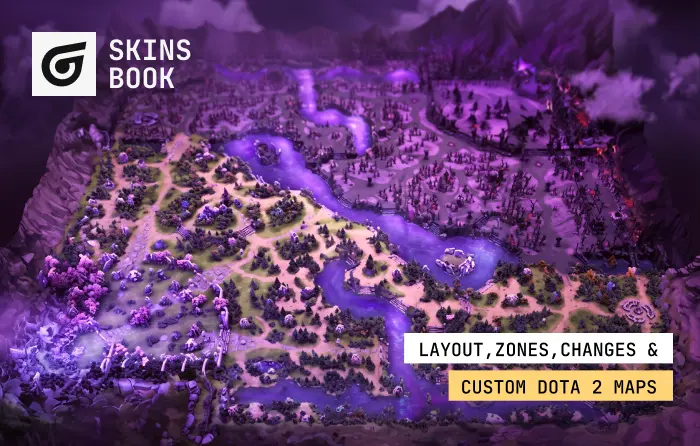
The Dota 2 map is a single symmetrical battlefield split diagonally between two factions: Radiant holds the bottom-left, Dire holds the top-right, and every pub game, ranked match, and pro tournament happens on this same map of Dota 2. Three lanes connect the bases — Safe Lane, Mid Lane, and Off Lane — each carrying a distinct strategic role in the early game. Between and around them spreads the Dota 2 jungle map, a zone packed with neutral creep camps that feed gold and experience outside lane farming.
The river cuts the Dota 2 map diagonally from top-left to bottom-right, separating the factions and serving as the main battleground for rune control. Objectives sit all over the map Dota 2 offers today: Roshan’s two pits, Twin Gates, Outposts, Lotus Pools, Tormentor, Defender’s Gates, and the Ancient at each base. Different Dota 2 characters interact with these zones in very different ways depending on their role.
Key Zones of the Dota 2 Map Explained
The map of Dota 2 breaks into distinct strategic zones, and knowing each one gives you a clean framework for decisions at every stage of the game — from the first creep wave to the final push.
The Three Lanes
The Safe Lane runs along the bottom edge for Radiant and the top edge for Dire — it is the carry’s main farming position and draws the most support attention early, simply because it sits furthest from the enemy jungle. The Mid Lane cuts straight through the center of the Dota 2 map and is the most contested single lane in the game: solo mids fight for rune control, experience leads, and rotation windows that can decide the first ten minutes.
The Off Lane sits closest to the enemy side of the map Dota 2 and carries the highest risk — Off Laners survive in hostile territory, disrupt the enemy carry’s farm, and force the opponent to spend resources defending instead of hunting objectives. Lane assignments are not fixed by the map of Dota 2 — they emerge from hero composition and matchups — but the physical lane positions on the map Dota 2 presents never change from game to game.
The Dota 2 Jungle Map
The Dota 2 jungle map is the network of neutral creep camps spread between and behind the lanes on both sides. Camps respawn every minute on a fixed timer and pay gold and experience to whoever clears them. Camp tiers run from Small Camps with modest rewards up to Ancient Camps that demand a strong hero to farm efficiently, and knowing which to prioritize when is a core farming skill.
The Radiant and Dire layouts are not perfectly symmetrical — small differences in camp positions, terrain angles, and tree lines have historically created minor side advantages that Valve irons out through targeted Dota 2 map changes in major patches. Stacking is the jungle’s signature mechanic: supports pull camp aggro right before the minute mark so multiple groups pile into one spot, multiplying the gold a carry can farm in a single clear. The Dota 2 jungle map also hides the game’s best ward spots at camp entrances and high ground — vision here tracks rotations just as well as lane vision does.
River, Runes, and Key Objectives
The river splits the Dota 2 map diagonally and hosts two Power Rune spots — these spawn every two minutes and grant temporary buffs like Haste, Double Damage, Regeneration, Illusion, Arcane, and Invisibility to the first taker. Bounty Runes appear every three minutes at four fixed locations across the map of Dota 2, and supports rotate specifically to claim them during laning since they pay guaranteed gold with no fight required.
Roshan lives in one of two pits on the Dota 2 current map — the Radiant pit by day, the Dire pit by night, walking between them through a portal, a mechanic the landmark Patch 7.33 introduced. Twin Gates sit in opposite corners of the Dota 2 map and teleport you instantly between both sides, a rotation tool that changed how teams use the full map of Dota 2 forever — one more reason the map Dota 2 plays today rewards fast information.
A single Tormentor spawns at the 20-minute mark in one of the map’s corners, swapping sides with the day/night cycle and always sitting opposite Roshan — killing it grants a free Aghanim’s Shard to a low-net-worth ally. Lotus Pools near the lane meeting points periodically grow fruit that restores HP and mana — free sustain for supports and junglers in the early and mid game.
Dota 2 Map Changes: How the Map Evolved and Where It Stands
The Dota all map began as a direct port of the original Defense of the Ancients Warcraft III battlefield — early versions of the Dota 2 map were far smaller and simpler, with fewer neutral objectives and a lane-focused strategy. Major Dota 2 map changes have always targeted meta imbalances: when a strategy dominates, Valve adjusts terrain, camps, or objective placement instead of only nerfing heroes.
The biggest single overhaul came with Patch 7.33’s New Frontiers update, which expanded the map by roughly 40% on all four edges and introduced Roshan’s dual pits, Twin Gates, Lotus Pools, Tormentors, and Defender’s Gates — permanently rewriting territory control and late-game decisions.
Unlike shooters that rotate fresh arenas every season, Dota never ships multiple Dota 2 maps for standard play — the studio evolves one battlefield continuously instead. That means Dota 2 maps change through patches, not replacements, and veterans of the Dota all map era from Warcraft III would still recognize the bones of the layout today.
Right now the Dota 2 latest map runs on patch 7.41f, released on September 15, 2026, per Valve’s official patch notes. The broader 7.41 cycle landed in March 2026, removed the Facets system entirely, and reshuffled items, while the 7.41d sub-patch on June 4, 2026 brought targeted hero and neutral-item tuning.
Each revision keeps the Dota 2 latest map subtly different from the one before it. Earlier, the 7.38 cycle had to fix a Radiant-side imbalance from tournament play: at DreamLeague Season 25, Radiant won 113 of 195 games — a 57.95% win rate — prompting Valve to adjust Dire Safe Lane Tier 1 tower placement, creep meeting points, and camp positions across several sub-patches.
The Dota 2 current map is the most strategically complex version the map Dota 2 has ever had, and anyone relying on pre-7.33 guides has real gaps in their knowledge. Checking the Dota 2 latest map notes after every major patch is a habit worth building. Staying current with Dota 2 map changes feeds directly into ranked performance — our Dota 2 ranks guide covers how the climb works.
The Dota 2 Lore Map: The Story and World Behind the Battlefield
The Dota 2 lore map is the fictional universe behind the battlefield, built through comics, the Artifact card game, the Dragon’s Blood animated series, and in-game cosmetic lore — every hero and location on the Dota 2 map has a place in a larger story that reaches back to the Dota all map mythology. The battlefield on the map of Dota 2 is a single flashpoint in that world: Radiant and Dire are not just teams but manifestations of ancient cosmic entities fighting over reality itself.
Even the Ancients you destroy to win are sentient beings in the Dota 2 lore map — fragments of an original cosmic power whose rivalry drives the whole narrative. Heroes arrive from distinct regions of this world, and their origins, allegiances, and histories shape their designs, voice lines, and ability flavor — narrative weight that pure competitive guides skip.
The Dragon’s Blood animated series pulled much of this world into the mainstream, introducing characters and locations that later echoed back into the game itself. Regions like the Thousand Tarns, the Roseleaf forest, and the fields of Stonehall all exist somewhere beyond the battlefield, and heroes reference them constantly in voice lines during a match on the map of Dota 2.
The Dota 2 lore map keeps expanding through limited events and seasonal content, and lore-connected cosmetics — items tied to hero backstories or big story beats — often carry serious market value, as our most expensive Dota 2 item guide shows.
How to Draw on the Dota 2 Map: Communication and Callouts
The Dota 2 draw on map feature lets you sketch lines, arrows, and markers straight onto the minimap mid-game — a communication tool that coordinates rotations, enemy positions, and team fight plans faster than voice chat alone. To use Dota 2 draw on map, hold Ctrl, left-click, and drag on the minimap; the line shows up briefly for all teammates in your color, then fades without cluttering the map. Different strokes mean different things on the Dota 2 map: a short tap marks a point of interest, a dragged line shows a movement path or rotation direction, and a looped circle highlights a danger zone or objective.
Practice Dota 2 maps in the Arcade gives you a safe place to build the habit. Shot-callers lean on Dota 2 draw-on-map hard for gank timing — an arrow from the jungle toward a lane on the map of Dota 2 says “incoming” faster and clearer than shouting during a tense moment. Used well, the Dota 2 draw-on-map habit is part of what separates organized teams from five strangers, and at higher MMR it sits alongside pings and voice as standard equipment.
Dota 2 Custom Maps: Workshop Modes and Community Games
Dota 2 custom maps are community-built game modes made with Valve’s custom game tools and published through the Steam Workshop — you access them right in the client under the Arcade tab with no extra download. Unlike the standard Dota 2 map, Dota 2 custom maps can rewrite everything: rules, win conditions, hero pools, ability sets, even the physical layout itself. The genre-defining example is Auto Chess, the Dota 2 custom maps phenomenon that invented an entire genre and spawned standalone titles from several studios — all born as a modification of the map Dota 2 runs on.
The catalog runs wide: casual party games, tower defense modes, and serious practice tools like 1v1 Mid Practice maps, last-hit trainers, and custom draft rooms that sharpen specific skills outside ranked. Joining Dota 2 custom maps takes zero setup — open the Arcade from the main menu, pick a game, and join a lobby exactly like a normal match on the regular Dota 2 map.
Quality varies, though: actively maintained maps keep pace with major Dota 2 map changes, while abandoned ones break after big patches until a developer returns. The deepest workshops even produce dedicated training Dota 2 maps built purely for drills, and a few community Dota 2 maps have grown large enough to host their own tournaments.
Dota 2 Map Skins and Visual Themes — How to Change How Your Map Looks
Dota 2 map skins — officially called terrains — swap the entire visual presentation of the Dota 2 map: colors, textures, foliage, lighting, and ambient sound all transform, while the layout, objectives, and mechanics of the map Dota 2 uses stay byte-for-byte identical. Historically, terrains have been exclusive Battle Pass rewards, which makes them some of the rarest cosmetics in the game.
The released lineup includes Desert Terrain (TI5), Immortal Gardens (TI6), Reef’s Edge (TI7), Emerald Abyss (TI8), Overgrown Empire (TI9), and Sanctums of the Divine (TI10) — each one reskins the Dota 2 current map completely without touching a single gameplay element. Missed a Battle Pass? Almost none of these terrains can be bought back — Battle Pass rewards are locked to the account that earned them, with no trading, gifting, or market resale possible.
The one exception is The King’s New Journey, sold directly through the Steam Community Market or the in-game store — the only terrain anyone can simply purchase. A separate route exists through Dota Plus: subscribers get access to rotating seasonal terrains (Spring, Summer, Autumn, Winter) for as long as the subscription stays active, though those terrains disappear once it lapses.
Equipping a Dota 2 map skin takes seconds: open your profile, go to Loadout, pick the Terrain slot, and select what you own — it applies to every future game. One clarification worth knowing: only you see your terrain. Teammates and opponents keep their own view of the Dota 2 map, so terrains are purely personal taste. High-detail terrains also add rendering load, so players on weaker rigs should check our Dota 2 system requirements guide before enabling the flashiest sets.
Master the Dota 2 Map — and Everything Else Follows
The Dota 2 map is the foundation every other skill in the game builds on. Whether you are learning the Dota 2 jungle map for the first time, tracking Dota 2 map changes after a major patch, using the Dota 2 draw on map feature to call rotations, or exploring Dota 2 custom maps to sharpen specific mechanics — every hour invested in map knowledge pays back in better decisions, cleaner rotations, and more confident plays. The Dota 2 current map rewards players who study it, and this guide gives you everything you need to start.
FAQ
Just one for standard play. Every ranked, unranked, and professional match uses the same Dota 2 map — Valve updates it through patches rather than adding alternatives. Variety comes from Dota 2 custom maps in the Arcade and cosmetic terrain skins.
The Dota 2 latest map runs on patch 7.41f, released on September 15, 2026. The big structural version dates back to Patch 7.33's New Frontiers expansion, which enlarged the battlefield by about 40%.
Yes — much bigger than classic Dota. The Dota all map of the early years was tiny by comparison, and the Dota 2 current map grew roughly 40% larger with the 7.33 update in 2023, adding Twin Gates, Lotus Pools, Tormentors, and a second Roshan pit. Players who remember older Dota 2 maps from the early days of the Dota all map will feel the difference immediately.
There is only one competitive map of Dota 2, so it wins by default. If you mean custom games, Auto Chess is the most influential Dota 2 custom maps release ever, while 1v1 Mid Practice is the favorite training tool.
Hold Ctrl, left-click, and drag on the minimap. Your team sees the line in your color for a few seconds before it fades — use Dota 2 draw on map for rotations, danger zones, and objective calls.
Terrains historically came as high-level Battle Pass rewards, and those stay locked to the account that unlocked them — no trading. Two other routes exist: buying The King's New Journey directly from the Steam Community Market or in-game store, or subscribing to Dota Plus for rotating seasonal terrains that last only as long as the subscription is active.
Only one: The King's New Journey is the sole terrain sold on the Steam Community Market. Every Battle Pass terrain — Desert Terrain, Immortal Gardens, Overgrown Empire, and the rest — is locked to the account that earned it, with no trading, gifting, or resale allowed.
Open your profile, enter Loadout, and pick your terrain in the Terrain slot — the new theme applies to all future games instantly. Only you see it; everyone else keeps their own Dota 2 map view.