
How to Play Rust: Rust Beginners Guide

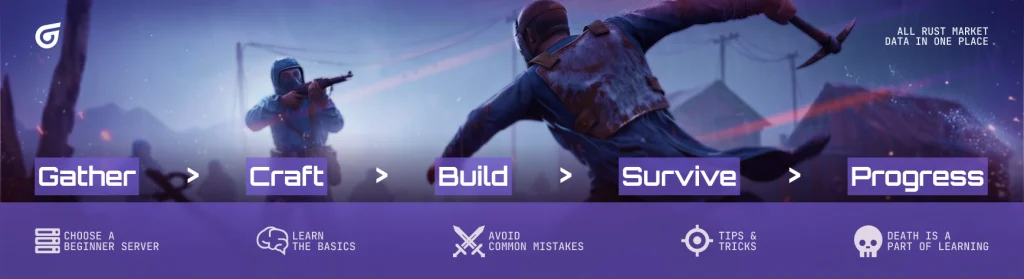
Rust is known as a hardcore multiplayer survival game. Starting with only a Rock and Torch, you need to survive, which requires gathering resources, crafting, building, and fighting. In fact, dying is another important part of learning the game. So, how to play Rust? Check out our guide for the basics of the game, how to choose a beginner-friendly server, surviving your first day, crafting and progression, beginner tips and common mistakes. And remember to do whatever you can to make it through another night.
Rust Basics: What Is Rust and How Does It Work?
Of course, it’s better to begin our guide with an intro to Rust. The game itself was first released in early access in December 2013. Only after almost five years, in February 2018, did Facepunch Studios release it in full.
However, from the beginning, Rust was positioned as a hardcore, multiplayer survival game. Each player starts on a post-apocalyptic island with only a rock and a torch. Your goal, along with other players’, is to survive in this online world.
For players who want to learn how to play Rust, it could be helpful to know that the main gameplay loop is a constant cycle of growth and risk-taking. First, you start by gathering basic resources (e.g. wood, stone) in order to craft primitive tools and weapons. As you collect materials, you must build a base to keep your loot safe. From this point, your task is to continue upgrading the equipment and base while defending them against other players.
Another important detail of Rust basics is that there are no quests or story mode. It is an open-ended, player-driven sandbox where you define your own goals.
Still, the gameplay of Rust also includes death. But it’s better to understand that death isn’t the end, yet such an experience shares its own disadvantages. For example, when your character dies, you drop every single item in your inventory. In other words, any player can now loot your corpse. You will respawn at a random beach or at a sleeping bag you placed. And, of course, you must rebuild your gear from scratch.
The last detail you should know about how to play Rust is that servers are also regularly wiped. It is a scheduled reset that completely wipes the map and resets all player progression. Such a feature helps keep server performance stable. And the more exciting detail is that it brings back the chaotic experience of the early-game survival race. But what exact server should you choose? Let’s find the answer in our Rust game guide below.
How to Choose the Best Rust Server for Beginners
Undoubtedly, choosing the best Rust server for beginners can be tough. Especially given that such a choice directly affects your experience from the beginning. Or, in other words, will you spend your first hours learning the Rust basics or getting instantly wiped out.
Official Servers
First, let’s explore the official servers in our beginner guide to Rust. The main difference is that they are hosted directly by Facepunch or major partners like Rustoria. Such servers feature maximum player capacities, high performance, and great uptime. At the same time, there are no active administrators who manage player behavior or limit group size. As a result, official servers are generally not recommended for beginners.
Community Servers
If you are looking for the best Rust server for beginners, then community servers could be your perfect option. While they are privately rented, these servers run the standard game rules. Still, the main difference lies in active moderation. Moreover, this is the place where you can find specific rules. For example, it could be a specific group size, like solos or trios only, or a beginner-friendly environment with toxic behavior banned. As a result, if you are looking for the best Rust server for beginners, community servers could be your perfect option.
Modded Servers
At the same time, there are modded servers that we cannot ignore in our beginner Rust guide. Such servers use custom plugins to change the core game loop. For example, among the most common changes are increased gathering rates. It allows players to collect more resources in less time, build a base or craft weapons, and practice high-tier gunplay and base building much faster. As a result, players looking for the best Rust server for beginners can also check out modded servers and get a different experience at a faster pace.
Which Server Should Beginners Play?
So, let’s check in our Rust beginners guide what server you should choose to play. Undoubtedly, the best option is to look for a community or modded server clearly marked as Beginner Friendly. Also, you need to aim for a low population count (e.g., less than 100 players). It allows you to minimize conflicts with other users.
Another important detail of Rust for beginners is to choose vanilla or 2x gather rates, along with a monthly wipe schedule. This combination gives you enough space to master core survival systems. And, of course, you have time to test building designs and learn to shoot before diving into the more advanced pace.
Before joining a server, it’s also worth checking the Rust system requirements to make sure your PC can handle the game smoothly, especially when playing on highly populated or modded servers.
Now, the next step you are ready to explore is how to play Rust.
How to Play Rust: Your First Day Survival Guide
Undoubtedly, waking up on a beach with only a rock could be a tough experience from the beginning. That’s why using a Rust beginners guide, such as ours, is the best way to understand the exact steps you should follow on your first day.
Gather Essential Resources
Of course, the first thing we should mention in our Rust guide is gathering essential resources. There are four kinds of them:
- Wood: Use your starting rock to hit trees.
- Stone: Look for shiny boulders and also use your starting rock.
- Cloth: Pay attention to the hemp fibers to gather the cloth.
- Food: Gather wild berries and corn near rivers.
In truth, gathering these resources is one of the main tips and tricks for Rust. It’s more important than exploring the map during your first few minutes of the game. The reason is that without them, you are an easy target. As a result, your session could end faster than you want.
Craft Your First Essential Items
For players who want to know how to play Rust, it is also important to understand the crafting order. Of course, it is a recommended order in our beginner guide to Rust, and you can simply change it after getting some experience.
First, you need to collect a few hundred units of wood and stone. Then, open your crafting menu. The first tools to craft are the Stone Hatchet and the Stone Pickaxe. By using them, you can harvest wood and nodes much faster than with your starting rock.
Now, it’s time to craft a Wooden Spear or Hunting Bow and Arrows. These tools will help you defend yourself against both wildlife and other players.
The last thing you need to make with cloth is your Sleeping Bag. This item works as a custom respawn point. In other words, when you die, you won’t respawn on a random beach.
Build a Simple Starter Base
The next detail in our Rust beginners guide is to quickly build a shelter. It will help you to secure your loot while you are offline. The best option for beginners is a 2×1 base (a footprint of two square foundations side by side). Also, remember to place a Tool Cupboard inside. This structure is important because it prevents others from building on top of you.
No less essential is to secure your entrance. Use a wooden or sheet metal door and a key lock. Moreover, using an airlock is a part of Rust tips and tricks. An additional small triangular structure with a second door near the entrance prevents players from slipping inside when you walk out. In the end, remember to upgrade your base from twig to stone. You can use your building plan and hammer. This part is no less important since players can easily break through twigs.
Mistakes to Avoid on Your First Day
Of course, mistakes are an essential part of learning the game’s nuances. Still, by following our beginner Rust guide, you could avoid most of them to keep your experience smooth. Let’s take a look at them below:
- Build near busy monuments: Avoid landmarks like Launch Site or Military Tunnels, as there are many heavily armed players there.
- Carry too much loot: Remember to drop your materials off at your base. Otherwise, there is a high chance of losing everything if you die in the process of exploring new areas.
- Fight geared players: It’s always better to run away if you face players wearing metal armor and carrying assault rifles, while you only have a bow.
- Trust strangers too quickly: There are a lot of players who are ready to say anything to steal your loot. Think twice before giving them access to your base.
- Ignore food or health: Remember to keep your calorie and hydration bars filled. It may also be of some use to carry a few cloth bandages. You can use them to stop bleeding during unexpected fights.
Rust Crafting Guide: Blueprints, Workbenches & Scrap
Since we already explored how to choose the best Rust server for beginners and your first day tasks in our Rust game guide, it’s time to learn more about crafting. As you already noticed, you can craft basic items (e.g., stone tools, wooden walls) anywhere on the island. Getting high-end gear requires specific knowledge and specialized equipment.
For example, to craft firearms, medical syringes, or metal armor, you need to first unlock their Blueprints. As soon as you learn it, you can use it until the server is wiped. For crafting, you need to use Scrap. You found this resource inside barrels and crates along roads or at abandoned monuments. Just gather gears, pipes, and springs, and run them through a Recycler at safe zones (e.g., Outpost) to break them down.
Still, players who are searching for how to play Rust may wonder how exactly you can unlock blueprints. In fact, there are two ways to do it. First, you can use a Research Table. Just place a physical item you found during looting, add a set amount of Scrap, and learn its blueprint. Another way is to use the Tech Tree in a Workbench. Just spend Scrap and unlock items even if you never found them in the game.
But what exactly is this Workbench? In short, it’s your crafting station. Depending on its tier, a Workbench lets you unlock items at that tier. There are three tiers:
- Tier 1 (Experimental): You can use it for crafting low-tier items. For example, revolvers, double-barrel shotguns, satchel charges, and basic wooden bases.
- Tier 2 (Advanced): This tier unlocks the Hazmat Suit, Semi-Automatic Rifles (SARs), medical syringes, and reinforced garage doors.
- Tier 3 (Elite): Here, while it’s extremely expensive to craft, you have access to military-grade Assault Rifles, rocket launchers, and heavy metal armor.
It’s also important to distinguish craftable gear from cosmetic items. Crafting determines which weapons, armor, and other equipment you can produce, while skins change their appearance. Some cosmetics can become particularly valuable on the community market, with the most expensive Rust skin costing significantly more than standard skins.
Rust Progression Guide: From Early Game to Late Game
Now, we should learn the exact steps in your gameplay in Rust from the early to the late game. In fact, understanding the pace of each phase could help you not just survive but also continuously upgrade your base and gear.
Early Game
The phase we should begin our Rust guide with is the early game. Here, your main goal is to gather enough wood and stone to build a 2×1 starter base. No less important is crafting primitive weapons (e.g., a hunting bow) and placing a sleeping bag. Additionally, during the early game, you need to farm roads, loot crates, and simply collect the first pieces of Scrap.
Mid Game
In mid-game, your progression shifts to the Tier 2 Workbench. Now, it’s time to unlock the Revolver and Semi-Automatic Rifle. Also, you should get a Hazmat Suit to safely farm radioactive monuments. In the end, you need to upgrade your base, making it closer to a fortress, along with garage doors.
Late Game
The late game simply shares high-tier firepower and massive fortresses. During this phase, you can already craft Assault Rifles, bolt-action snipers, and heavy metal plate armor. Now, you are not farming to survive, but to conquer elite-game monuments and destroy others’ bases to get their loot. Still, we should mention that everything will be destroyed with a server wipe, forcing everyone back to the beach with a rock.
But are there any Rust tips and tricks it’s better to know at the beginning of the game? Let’s explore them below.
Rust Tips and Tricks Every Beginner Should Know
Of course, this guide couldn’t be complete without tips and tricks for Rust. In truth, there is a list of them. And, to avoid any misunderstandings, we provide them below one by one:
- Among the most common Rust tips and tricks is upgrading your base to stone quickly. Of course, it is because it will be harder for other players to destroy it. Otherwise, they can burn wood walls with flame arrows or simply break them with basic tools.
- Also, the trickiest part is to place multiple Sleeping Bags around your base and near key areas like monuments. By doing that, you can quickly get back into the action after a death.
- Another detail in tips and tricks for Rust is to farm roads for Scrap. It is the safest way for a beginner to gather Scrap and components at the start.
- No less important to remember that you can recycle unnecessary components. For example, you can use items like car parts, blades, and propane tanks. And, by putting them into a Recycler, you can get raw Scrap, metal fragments, and cloth.
- Of course, players searching for guides on how to play Rust should often store loot at their base. If you die after hours of looting, you lose everything you have in your inventory.
- In fact, the previous tip is to carry only what you need when you leave a base. For example, if you are cutting trees, you don’t need to risk your best armor and firearms.
- Rust tips and tricks include learning monument layouts. Exploring them, especially smaller ones, will allow you to understand where crates spawn and the exit routes to loot efficiently and escape danger.
- As in real life, you always need to lock your doors. In fact, it’s one of the most crucial details you shouldn’t ignore. If you forget to lock a key lock or leave a door wide open, then another player can easily take over your entire base.
- In fact, there is one thing among tips and tricks for Rust that players completely ignore in other titles as well: sound. Sound is not something unnecessary in the background, but an essential tool and ally. It allows you to determine an enemy’s position before they see you. Moreover, it could be helpful to know that footsteps change depending on the surface (wood, stone, dirt).
- Of course, another important tip is to avoid unnecessary fights. It is always better to get your loot home safely than to get a kill.
- If you still want to test your aim, then first practice PvP on training servers. It will help you build muscle memory safely and increase your chances of winning in a real fight.
- Nights in Rust could be especially dangerous for beginners. It’s better to begin your activity in the morning and explore the map at night after getting some experience.
- The last tip is to learn from every death. Remember that it’s not the end, but the best teacher. Analyze what went wrong and adjust your strategy for the next attempt.
Another trick we can’t ignore is using the right tool when you want to buy or sell items at the best price. Check the market value of your skins, compare the item’s cost, and track the lowest and the highest price on multiple platforms at once.
Common Beginner Mistakes in Rust
Of course, the tutorial should also include mistakes beginners make in Rust. In truth, understanding them can save you hours of loot and craft. And, of course, one of the most common mistakes is to build massive bases too early. The issue is that you need to supply your Tool Cupboard with daily materials. Otherwise, your base will literally decay into ruins. That’s why it is important to run a 2×1 layout until you have stable resources.
Another popular mistake is carrying too much loot and ignoring Scrap farming. First, it makes you an attractive target for other players. Second, focusing on building materials and ignoring Scrap farming will stop your technology progression altogether.
Also, some players prefer to explore major landmarks without the proper gear. In fact, entering dangerous monuments too soon is a death sentence. While there could be larger groups, you also cannot ignore radiation or cold.
Of course, in continuation of the previous mistake in our Rust beginners guide, you also shouldn’t fight stronger players. You simply cannot win a duel with a bow against a gun. Pick each battle wisely and remember that it’s better to slip away unnoticed than lose your loot.
No less important is avoiding cheats in the game. First, it strictly violates the game’s rules. While some users think that only servers with active moderators are closed for this experience, the game uses Easy Anti-Cheat (EAC). Moreover, Facepunch Studios enforces hardware ID (HWID) bans. In other words, even if you use the “best Rust cheats,” there is a high chance of being banned, and even creating a new Steam account won’t bypass this restriction.
In the end, remember that death isn’t the end in Rust. It’s rather a valuable lesson you shouldn’t give up after. It is a chance to understand better positioning or base security, not a total failure.
Rust Beginner Progression Checklist
The last detail in our Rust beginners guide is a simple checklist of what you need to do in the game. But before we provide this list, it’s better to understand that your actual progression strongly depends on the server type. No less important is the current stage of the wipe cycle. In the end, your overall experience plays a huge role.
- Your first step is to spawn and collect wood, stone, cloth, and food.
- Then, you need to craft basic tools and weapons.
- Remember to place a Sleeping Bag.
- No less important is building a small 2×1 starter base after you’ve done the previous steps.
- And, for sure, you should upgrade the base to stone.
- The next step is to farm Scrap from roads and recyclers.
- Now, it’s time to build a Tier 1 Workbench inside your base.
- Also, unlock essential Blueprints (e.g., the Revolver) by using Scraps.
- Now, you can upgrade weapons, armor, and tools.
- The last step is to expand the base and prepare for monument runs and PvP.
By following these steps, you can expect to get a successful start and progress more confidently through Rust. Once you understand the basics, you can focus on more advanced activities, including monument runs, base expansion, and PvP. If you’re also interested in learning the fundamentals of other competitive games, check out our how to Play Dota 2 guide for a step-by-step introduction.
Conclusion
Rust is a place where you need to master survival skills to stay alive. Gathering, crafting, building, surviving, and improving are the keys to last another night. Of course, it doesn’t mean you need to understand everything from the beginning, but rather focus on one mechanic at a time and hours of gameplay. Remember that even experienced players started as beginners who could barely survive. In the end, every death is an important lesson. And each server wipe is a fresh opportunity to become a better Rust player.
FAQ
It’s not by default since you need to master survival skills. Still, there are beginner-friendly servers where you can explore the game much more smoothly.
Your first-day priorities are gathering wood, stone, and cloth to craft basic tools and a bow. Also, you need to place a sleeping bag. No less important is to remember to build a stone base.
The best one is the server with a low population count. For example, under 100 players. It will help you learn the game without constant attacks.
After you die, you respawn at a random beach. If you have placed a sleeping bag, then you will respawn near it. Your inventory is dropped with your corpse, which means everyone can loot it.
You need to hit barrels and loot crates along roads. Then, take the components to a safe-zone Recycler at the Outpost to break them down.
It is possible, yet it could be tough against large teams. If you want to survive on your own, it might be better to play on solo or solo/duo servers.
While each experience is unique, you can expect to learn the basics quickly (less than 10 hours). At the same time, mastering various skills like weapon recoil, advanced base building, raiding strategies, and monument puzzles can take tens or hundreds of hours.
They exist in the game. Still, it strictly violates the game’s rules. Also, active server moderators often ban cheaters.
It is an online game with no ending. But if you refer to progression, a typical wipe cycle can take anywhere from a few hours or days to weeks before resetting.
You need to spend time practicing building, farming, monument runs, and PvP while learning from each wipe.


Be the first to share your thoughts.