
Dota 2 Ranks Explained: Complete Dota 2 MMR & Tier Breakdown

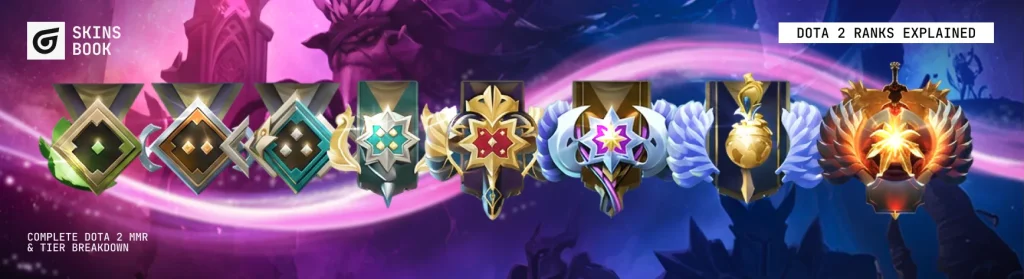
Ranked Dota 2 runs on two things at once: a numerical matchmaking rating and the visible rank medals sitting on top of it. There are eight main medal tiers, from Herald all the way to Immortal, but the underlying Dota 2 matchmaking rating decides where you actually sit on the competitive ladder. This guide walks you through every one of the Dota 2 ranks, how MMR works, the MMR requirements for each medal, Rank Confidence and calibration, the current MMR distribution Dota 2 players sit in, Immortal and the regional leaderboards, and how the ranking system in Dota 2 lets you climb. If you want the full picture of Dota 2 ranks in 2026, keep reading.
What Are Dota 2 Ranks?
A Dota 2 rank is the public face of your competitive skill. Underneath every medal sits a hidden number — your MMR — and the medal simply translates that Dota MMR rating into a badge everyone can read. Your visible medal and your underlying rating are not the same thing: two players can show identical medals while the MMR on Dota 2 accounts differs by a hundred points or more.
The ranking system in Dota 2 uses skill-based matchmaking, so games stay fair and competitive, which is why ranked matches feel different from unranked ones. In unranked, the stakes stay casual, and the matchmaker relaxes. In ranked, every win pushes your rating up, and every loss pulls it down, so Dota 2 ranked rankings shift after each game. One match never defines you, though — your rank represents an estimated skill bracket built over many games, not a verdict on a single performance.
The progression runs Herald, Guardian, Crusader, Archon, Legend, Ancient, Divine, and finally Immortal. Herald through Divine each contain five subdivisions shown as stars, while Immortal works differently — more on that below. If you are completely new, learn how to play Dota 2 first and worry about ranked progression later.
How Does the Ranking System in Dota 2 Work?
The ranking system in Dota 2 exists for one reason: to estimate your skill and build balanced lobbies around that estimate. When you queue for a ranked game, the matchmaker reads your Dota 2 ranking system MMR value and pairs you with nine players of similar rating. Your MMR directly shapes who you play with and against, which is why Dota 2 ranked rankings stay the backbone of competitive matchmaking.
Because medals cover ranges, two players flashing the same medal may not hold exactly the same MMR — a Legend I and a Legend V share a badge family but sit roughly 600 points apart. Medal progression simply follows the underlying rating: cross a threshold and the badge upgrades. One more thing surprises people — individual K/D/A or damage numbers do not convert directly into rank points. The Dota 2 ranking system MMR model rewards team results, so a support with a quiet scoreboard gains exactly what the carry gains when the team wins. Personal stats help you win; they never replace winning.
Dota 2 Medal Ranks vs. MMR
| Element | Dota 2 Rank | Dota 2 MMR |
|---|---|---|
| Format | Medal/tier | Numerical rating |
| Example | Legend III | 3,450 |
| Visibility | Public-facing rank | Primarily your rating |
| Purpose | Easy representation of skill | Matchmaking and rating calculation |
| Changes | Follows rating progression | Changes through ranked results |
Keep in mind that medal thresholds are not permanently fixed — Valve can shift them, so treat every numerical range in this guide as a current reference, not an eternal rule.
All Dota 2 Ranks From Lowest to Highest
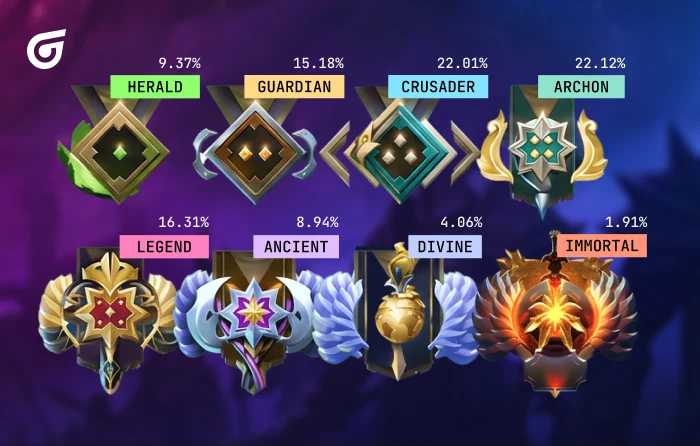
Here is the full ladder of Dota 2 ranks at a glance — the table of Dota 2 rankings below gives you the answer immediately, and the short breakdowns after it explain what each of the Dota 2 ranks usually looks like in practice:
| Order | Rank | Divisions | General Skill Level |
|---|---|---|---|
| 1 | Herald | I–V | Entry level |
| 2 | Guardian | I–V | Beginner |
| 3 | Crusader | I–V | Developing |
| 4 | Archon | I–V | Intermediate |
| 5 | Legend | I–V | Above average |
| 6 | Ancient | I–V | Advanced |
| 7 | Divine | I–V | Highly skilled |
| 8 | Immortal | No standard I–V divisions | Elite |
Herald
The lowest medal tier. Players here typically keep developing basic mechanics, map awareness, farming efficiency, positioning, and hero familiarity.
Guardian
Guardian players usually understand their heroes and basic objectives better, while consistency and decision-making continue to develop.
Crusader
Crusader is where stronger mechanical understanding generally shows up, though map movement, itemization, and coordination can still lag behind.
Archon
The middle of the competitive ladder. Archon rewards increasingly consistent fundamentals — shaky basics stop working here.
Legend
Legend players tend to bring stronger mechanical execution, farming patterns, positioning, hero matchup knowledge, and objective awareness.
Ancient
Mistakes become genuinely punishable in Ancient, and players generally show stronger strategic understanding across the map.
Divine
Divine means advanced mechanics, drafting awareness, sharp map movements, timings, and real coordination with teammates.
Immortal
The highest of all Dota 2 ranks, and progression here ditches the medal-and-star system entirely. Even the drafting stage works differently: below Immortal you lock in the exact role you will play, but Immortal lobbies only let you mark your preferred role. The game then takes the two highest-rated players out of the ten and makes them captains of the Radiant and Dire, and those captains draft their teammates one by one. If a captain picks two players who both want the offlane, you sort it out between yourselves — negotiation skills included, free of charge. Pre-made parties stay out of this bracket, and the Dota 2 rankings at the very top turn into a public number race on the Dota 2 leaderboards.
Dota 2 MMR Explained
MMR stands for matchmaking rating — a numerical estimate of your competitive skill. The MMR on Dota 2 profiles exists so the matchmaker can build fair games, and every ranked result nudges it up or down. Wins push the number up, losses drag it down, but the changes are not identical every time. Since the New Frontiers update in April 2023, the ranking system in Dota 2 runs on a Glicko-based model, and under Glicko the size of each adjustment depends on factors like rating differences and Rank Confidence.
One thing worth burning into memory: your Dota 2 MMR has nothing to do with account level, hours played, Battle Pass progress, or cosmetic value. The Dota 2 MMR ranking you earn reflects results only. Also, because Valve has reworked matchmaking substantially over the game’s lifetime, always sanity-check current details against official sources — the Dota 2 ranking system MMR rules of 2019 are not the rules of today.
How Do You Gain and Lose MMR in Dota 2?
Ranked results decide the direction: win and your rating rises, lose and it falls. The size of each move varies, though. Rating uncertainty matters, Rank Confidence matters, and the gap between the two teams matters. With high confidence, games tend to move close to plus or minus 25 MMR, but nobody should expect a fixed +25/-25 forever — Valve’s own notes say changes stay variable. And no, dropping 30 kills in a loss does not hand you bonus points, because personal performance never simply awards extra Dota 2 MMR on its own.
Dota 2 Rank Confidence and the Glicko System
Since April 2023, the Dota 2 ranking system MMR engine runs on Glicko — a rating model that tracks two numbers instead of one. Your rating estimates skill, and Rank Confidence measures how sure the system feels about that estimate. In plain terms, the Dota MMR rating tells the matchmaker where you belong, and confidence tells it how loudly to listen.
Why does the system need confidence at all? Because an estimate without certainty is just a guess. Every ranked game you play feeds the model fresh information, so confidence generally climbs as you play and the Dota 2 ranking system MMR adjustments settle down. Return after months away and the opposite happens: the system grows less certain that your old rating still fits, confidence drops, and your rating swings get larger while the MMR on Dota 2 recalibrates around you. Lower confidence means bigger adjustments per game — that is the whole practical takeaway. Valve uses a comparable confidence idea in Counter-Strike too, and our CS2 ranks guide breaks that version down.
What Does 30% Rank Confidence Mean?
Around 30% is the calibration threshold that matters most. Community documentation and Valve’s own descriptions put it this way: once Rank Confidence reaches roughly 30%, the system considers you calibrated and shows your medal. Below that line, your medal stays hidden, and the MMR on Dota 2 keeps moving in bigger steps until enough games rebuild certainty.
Does Rank Confidence Decrease?
Yes — inactivity slowly lowers it. The system simply becomes less sure that an old rating still represents your current ability, so Dota 2 ranked rankings can visually change after a long break. That is not conventional automatic rank decay eating your MMR; it is the confidence layer cooling off.
Dota 2 MMR Ranking by Medal
Medal thresholds can change, so treat every number here as an approximate community-tracked reference rather than a permanent Valve rule — Valve has never published an official threshold list, and statisticians maintain this one by watching enormous match samples. With that said, here is the full dota 2 mmr ranking table players currently work from, and it covers the whole Dota 2 MMR ladder from the first Herald star to the Immortal cutoff:
Dota 2 MMR Rank Table
| Rank | Division | Approx. MMR |
|---|---|---|
| Herald | I | 1–154 |
| Herald | II | 154–308 |
| Herald | III | 308–462 |
| Herald | IV | 462–616 |
| Herald | V | 616–769 |
| Guardian | I | 770–924 |
| Guardian | II | 924–1,078 |
| Guardian | III | 1,078–1,232 |
| Guardian | IV | 1,232–1,386 |
| Guardian | V | 1,386–1,540 |
| Crusader | I | 1,540–1,694 |
| Crusader | II | 1,694–1,848 |
| Crusader | III | 1,848–2,002 |
| Crusader | IV | 2,002–2,156 |
| Crusader | V | 2,156–2,310 |
| Archon | I | 2,310–2,464 |
| Archon | II | 2,464–2,618 |
| Archon | III | 2,618–2,772 |
| Archon | IV | 2,772–2,926 |
| Archon | V | 2,926–3,080 |
| Legend | I | 3,080–3,234 |
| Legend | II | 3,234–3,388 |
| Legend | III | 3,388–3,542 |
| Legend | IV | 3,542–3,696 |
| Legend | V | 3,696–3,850 |
| Ancient | I | 3,850–4,004 |
| Ancient | II | 4,004–4,158 |
| Ancient | III | 4,158–4,312 |
| Ancient | IV | 4,312–4,466 |
| Ancient | V | 4,466–4,620 |
| Divine | I | 4,620–4,820 |
| Divine | II | 4,820–5,020 |
| Divine | III | 5,020–5,220 |
| Divine | IV | 5,220–5,420 |
| Divine | V | 5,420–5,620 |
| Immortal | — | 5,620+ |
The broad picture: each medal from Herald through Ancient spans roughly 770 MMR, with one star worth about 154 points, while Divine stars cover about 200 each. Quick answers for common lookups: 1,000 MMR sits in Guardian II, 2,000 lands in Crusader III, 3,000 MMR is Archon V closing in on Legend, 4,000 puts you in Ancient I, and 4,500 means Ancient V with Divine in sight. At 5,620, the door to Immortal opens — the point where Dota 2 MMR standings stop being about stars at all, and where the Dota 2 rankings turn into a numbered race. Keep this Dota 2 MMR ranking scale bookmarked, because the Dota 2 MMR gaps between stars never change even when the thresholds themselves shift.
Dota 2 Ranks Distribution
The Dota 2 ranks distribution measures what percentage of the ranked player base sits inside each rating bracket. Why does the MMR distribution in Dota 2 data matter? Because raw numbers mean little without context — a percentile tells you what share of players you outrank, and the average player does not sit at the mathematical midpoint of the scale. The densest part of the MMR distribution in Dota 2 lives in the Guardian-to-Archon band, while Divine and Immortal players are genuinely uncommon compared with the central brackets. The Dota 2 rankings also drift over time: new players flood the lower brackets, veterans return, patches change who queues, and every shift reshapes the Dota 2 ranks distribution a little. That is why any MMR distribution Dota 2 snapshot ages — treat the numbers below as a current photo, not a permanent map.
Dota 2 MMR Distribution by Rank
Here is how the Dota 2 ranks distribution looks right now — community-tracked estimates, per the August 2026 seasonal dataset from Esports Tales — third-party figures, not permanent official Valve statistics:
| Rank | Approx. Player Share | Approx. Percentile |
| Herald | ~12% | 0–12 |
| Guardian | ~19% | 12–31 |
| Crusader | ~20% | 31–51 |
| Archon | ~17% | 51–68 |
| Legend | ~13% | 68–81 |
| Ancient | ~9% | 81–90 |
| Divine | ~6% | 90–96 |
| Immortal | ~4% | 96–100 |
What Is the Average Dota 2 Rank?
Three different answers exist here, and they are not interchangeable. The median player lands around Crusader V, near the 51st percentile. The most populated medal band is Crusader, holding roughly a fifth of the ranked base. And the true mathematical mean of the MMR distribution in Dota 2 sits a bit higher than the median, because high-MMR outliers pull the average up.
How Dota 2 Ranked Calibration Works
“Uncalibrated” simply means the system lacks enough recent data to show your medal. Calibration is how it gathers that data: every ranked game raises Rank Confidence, and once confidence reaches roughly 30%, your visible medal appears. Previous matchmaking information can seed the process, so a returning account does not start from zero — but nobody plays exactly the same number of calibration games, because confidence, not a fixed match count, drives the finish line. Coming back after prolonged inactivity also differs from starting fresh: a veteran account recalibrates around its old Dota MMR rating, while a brand-new one gets placed aggressively from scratch. Expect wild swings during this stretch: early calibration games can move the MMR on Dota 2 far more than the standard adjustment, so treat every one of them like a playoff game. Either way, Dota 2 ranked rankings only stabilize once the system trusts its estimate again.
How to Unlock Ranked Matchmaking
Current requirements for ranked access:
- At least 100 hours of unranked playtime on the account.
- A unique phone number linked to your Steam account.
These gates exist mainly to fight smurfing. And before you grind that 100 hours, make sure your PC handles the game smoothly — our Dota 2 system requirements guide covers every spec you need for competitive play.
Dota 2 Leaderboards and Immortal Rankings
Reaching Immortal makes you elite, but it does not automatically hand you a leaderboard number. The Dota 2 leaderboards track the very top of each region separately, and positions there move constantly as players win, lose, and pass each other — a spot you hold tonight can vanish by morning. Extremely high-MMR players effectively compete inside their own regional pool, and a leaderboard slot is not a normal medal subdivision — it is a live position in the Dota 2 MMR standings, visible to everyone and chased by pros. This is also where Dota 2 MMR ranking stops being personal: at the summit, your number is public property. Valve splits the Dota 2 leaderboards into four divisions — Americas, Europe, Southeast Asia, and China — and states outright that regional MMR scales are not directly meaningful to compare, which is why no global Dota 2 leaderboards exist. For everyone else, the Dota 2 rankings inside your own region are the only measuring stick that matters.
How Do Dota 2 Leaderboards Work?
Per Valve’s official leaderboard page, eligibility requires all of the following:
- At least 300 lifetime matchmade games (unranked or ranked PvP only).
- At least 100 lifetime ranked games.
- At least 14 calibrated ranked games in the last 21 days in the same division.
The Dota 2 leaderboards update hourly, so the Dota 2 MMR standings can shuffle overnight — at that level, every Dota 2 MMR ranking position is public property.
How to Increase Your Dota 2 Rank and MMR
Climbing the Dota 2 MMR ranking ladder comes down to boring, repeatable habits rather than magic. Forget one weird trick — the ranking system in Dota 2 rewards small edges compounded over hundreds of games. Here is what actually moves Dota 2 ranked rankings over time.
Focus on a Small Hero Pool
Specializing in a handful of heroes cuts variables out of your games. You learn matchups, power spikes, and mechanics deeply instead of relearning a new kit every night, and that frees your brain for the map. Getting to know different Dota 2 characters is great for knowledge — just keep your ranked pool tight.
Master One or Two Roles
Constantly swapping between all five positions slows improvement, because each role trains different instincts. Pick one main role and one backup, then let repetition do the work — role discipline shows up in your Dota 2 MMR ranking within a few months.
Improve Your Map Awareness
Build the minimap habit:
- Check the minimap every few seconds.
- Track missing heroes before committing.
- Respect ward coverage and place your own.
- Watch teleports and rotations.
- Play around Roshan timings.
- Follow objective movements across the map.
Improve Farming and Resource Efficiency
Last hits win lanes before kills do. Work on lane equilibrium, jungle efficiency, item timings, and cutting dead time where you walk around accomplishing nothing.
Play Around Objectives, Not Just Kills
Kills are a means, not the goal. Towers, Roshan, Tormentors, map control, and high-ground pressure actually end games — chase structures, not scoreboard lines.
Review Your Losses
After a defeat, check:
- Your deaths and when they happened.
- Positioning in fights.
- Item choices for the specific game.
- Missed timings.
- Farming patterns.
- Teamfight decisions.
Keep Your Ranked Sessions Consistent
Tilt and fatigue quietly tank win rates. Set a stop-loss for yourself, take breaks after rough games, and never chain-queue through a losing streak hoping the Dota 2 ranking system MMR gods owe you one. They do not — the Dota 2 rankings respond to habits, not hope.
Common Dota 2 Ranking Mistakes
Plenty of players grind for months and stay stuck because of habits, not skill. The usual suspects: constantly changing roles, which resets your learning curve every few games, and playing too many unfamiliar heroes, which turns every match into a tutorial. Then come the analytical traps: obsessing over K/D/A instead of impact, ignoring objectives while hunting kills, and copying professional builds without understanding why they work in those specific drafts. Add two mental traps — continuing to queue while tilted, and blaming every loss on teammates — and the picture is complete. None of it means the ladder is rigged against you. Finally, treating MMR as the only measurement of improvement is itself a mistake. The ranking system in Dota 2 rewards better decision-making over large samples, and Dota 2 ranked rankings follow growth in fundamentals with a delay. Watch your replays honestly, and your Dota 2 MMR ranking catches up — Valve built the system to work exactly that way.
Does Dota 2 Have Rank Decay?
Short answer: not in the classic sense. Your MMR does not melt away by a fixed amount per day or week while you are gone. What decreases through inactivity is Rank Confidence — the Glicko system simply grows less certain that an older rating still represents your current skill, so your displayed Dota 2 ranked rankings can change, and your first games back swing harder. Drop far enough below the confidence threshold and your medal hides itself until you play enough matches to recalibrate. That distinction matters: Dota 2 ranked rankings after a break reflect uncertainty, not punishment. The Dota MMR rating itself only moves through match results, so a month away costs you sharpness, not points.
What Affects Your Dota 2 MMR?
Scoreboard watchers love to overvalue personal stats, so here is the honest breakdown of what your Dota 2 matchmaking rating actually reacts to:
| Factor | Direct Effect on MMR? | Explanation |
|---|---|---|
| Match result | Yes | Winning/losing affects rating |
| Rank Confidence | Yes | Influences certainty and potential adjustment |
| Kills | Not directly | Helps only insofar as it contributes to winning |
| Hero damage | Not directly | Performance stat rather than direct rating award |
| Account level | No | Separate progression metric |
| Cosmetics | No | No matchmaking skill value |
| Item value | No | Market price does not affect skill rating |
Cosmetic value has zero to do with matchmaking — even when you carry the most expensive Dota 2 item in your inventory, the MMR on Dota 2 does not care. Cosmetic markets value and competitive Dota 2 matchmaking rating measure completely unrelated things, and the Dota 2 ranking system MMR will never ask what your wardrobe cost.
Final Thoughts on Dota 2 Ranks and MMR
Dota 2 combines a numerical MMR with medal ranks: Herald opens the ladder, and Immortal closes it. Rank Confidence tells the matchmaker how reliable your rating looks, the MMR distribution Dota 2 shows how you compare with the broader ranked population, and the ranking system in Dota 2 ultimately rewards one thing — winning more often than you lose. Treat your Dota MMR rating as a thermometer, not a verdict: it measures where you are, never where you could be. Improving fundamentals and decision-making beats obsessing over short-term rating swings every single time. Climb smart, and the Dota 2 ranks and Dota 2 rankings will follow.
FAQ
The dota 2 ranks in order are Herald, Guardian, Crusader, Archon, Legend, Ancient, Divine, and Immortal. Every medal from Herald through Divine splits into five stars and maps to a slice of your dota mmr rating, so the full ladder covers 35 subdivisions before Immortal, which uses leaderboard placement instead of stars.
MMR means matchmaking rating — the numerical estimate of your skill that the ranking system in Dota 2 uses to build fair games. Your Dota 2 matchmaking rating rises with wins, falls with losses, and decides who you get matched with, while the medal on your profile simply visualizes a range of that number.
"Good" depends on context, but the MMR distribution dota 2 data helps. The median player sits around 2,300 MMR near Crusader V, so anything above that beats half the ranked base. Reaching Legend at roughly 3,080 already puts you inside the top third of all Dota 2 rankings.
Immortal starts at approximately 5,620 MMR on the current community-tracked scale. Crossing that line trades the star system for regional leaderboard eligibility, where the very best players in the Dota 2 MMR standings fight for numbered positions instead of medals.
Around 3,000 MMR places you at Archon V, roughly 80 points away from Legend I. On the dota 2 ranks distribution curve, that puts you somewhere near the top third of ranked players — above the median, with the next medal upgrade genuinely close.
Immortal is the highest rank in Dota 2. Above the Immortal threshold, the competition shifts to the regional Dota 2 leaderboards, where the Dota 2 MMR standings update hourly across the Americas, Europe, Southeast Asia, and China divisions.
Open your profile in the Dota 2 client and check the Stats tab — your exact MMR and current Rank Confidence percentage appear there. Only you see the precise number; everyone else just sees your medal. The MMR on Dota 2 profiles stays private by default.
No forced seasonal resets exist anymore. Since the April 2023 Glicko overhaul, your rating persists, and Valve instead offers an optional recalibration you can trigger about once per year from the account settings. Your Dota 2 MMR carries over as the starting point either way.
There are eight Dota 2 ranks: Herald, Guardian, Crusader, Archon, Legend, Ancient, Divine, and Immortal. Counting the five stars inside each of the first seven medals, the ladder holds 35 subdivisions plus Immortal at the top.
You cannot lose MMR itself to inactivity, but Rank Confidence drops when you stop playing. Fall below roughly 30%, and your medal disappears until you recalibrate through new games. So the Dota 2 ranked rankings display can change after a long break, even though the underlying number never decayed on its own.


Be the first to share your thoughts.