CS2 Ranks: Premier & Competitive Ranking System

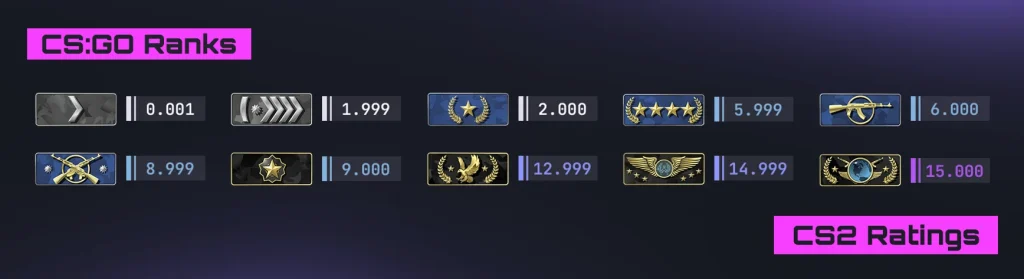
With the release of CS2, Valve completely overhauled their approach to the competitive experience by introducing updated CS2 (CS:GO) ranks. CS2 now features two separate ranking systems, and wrapping your head around them right away might be a bit tricky.
Right now, CS2 (CS:GO) ranks are split between Premier, which uses a numerical CS Rating, and Competitive, which sticks to the classic Skill Groups from Silver to Global Elite. As you might guess, both systems rely on skill-based matchmaking but follow completely different rules and carry different levels of seriousness. Your rank dictates who you play against and where you stand among millions of players.
In this guide, we’ll break down exactly how each system works, how the algorithm calculates your rating, and what it takes to boost your rang (CS:GO) CS2.
What Are CS2 Ranks?
Let’s start from the top and figure out exactly what CS2 (CS:GO) ranks are. Ranks in CS2 serve as a skill evaluation system that determines the caliber of your matchmaking opponents. Simply put, your rank shows how good you are compared to the rest of the player base and ensures you queue into people around your own skill level.
But there’s a crucial catch that many players miss at first. CS2 runs two distinct types of ranks, and they function entirely differently:
- Visible rank is what you actually see on your profile: the colored Skill Group badge or your numerical CS Rating. This is the metric displayed to other players.
- The hidden rating component – Valve has never officially confirmed the existence of a separate “hidden MMR” in CS2.
However, players have spent years noticing patterns that are hard to explain any other way. The most common example: a player takes a long break from the game, comes back, and their numerical rating hasn’t moved, but their lobbies suddenly feel entirely different. Teammates play worse, and opponents seem lower tier – even though the profile number remains exactly the same.
It feels like the system recalculates something behind the scenes after a long pause, even if your visible rating doesn’t shift. Valve keeps quiet on whether an actual hidden metric exists, but the community has piled up enough observations to prove it’s not just random chance.
Now, let’s briefly look at how the two matchmaking modes operate in CS2 – Premier and Competitive:
The CS2 (CS:GO) rank system in Competitive mode uses the 18 classic Skill Groups – from Silver I up to Global Elite. These ranks are tied to specific maps. You might hold one rank on Dust2, but rock a completely different one on Mirage. In our opinion, this is one of the smartest changes Valve made for CS2. CS:GO handled this poorly – you had one global rank across every map. If you hit Master Guardian Elite, the game threw you against MGEs regardless of which map you queued.
The problem? Map knowledge is half the battle in Counter-Strike. You can be a god on Dust2, knowing every angle and wallbang, but step onto Mirage without knowing a single smoke or flash. CS:GO completely ignored that difference. You were considered equally skilled everywhere. CS2 fixes that unfairness. Now, your rank on any given map reflects your actual skill level on that specific map, rather than just an average across your entire loadout of maps.
Premier mode brings a completely new system that didn’t exist in CS:GO. Valve ditched the rank badges for a numerical CS Rating ranging from 1,000 to 30,000+, split into seven colored tiers. This serves as a universal rating covering all maps at once, reflecting your overall game sense and skill. If Competitive feels like classic CS:GO matchmaking, Premier leans much closer to the Faceit experience – numerical ratings, transparent math, and a clear picture of what you stand to win or lose before the match even begins.
Another massive difference: Premier features a map veto phase before every match. Both teams ban maps until the system locks in where you’ll play. This injects a tactical element before round one even starts – you can ban your weakest map or force your opponents onto your strongest.
On top of that, Premier runs on seasons. Your rating resets every season, forcing you to constantly prove your skill instead of coasting on past glory. Because of this, most hardcore grinders treat Premier as the main competitive mode and use Competitive mostly as a practice ground to learn specific maps.
This exact duality is what makes all CS2 ranks a topic you need to fully grasp, not just skim over.
How Does the CS2 Ranking System Work?
Understanding the actual mechanics behind the CS2 (CS:GO) rank system is half the battle when trying to rank up. Most players think they just need to win matches. In reality, the algorithm tracks a lot more factors, and ignoring them means you’ll be hard-stuck for years.
Wins and Losses – The Core Factor
The match result forms the absolute foundation of your rating calculation. A win boosts your rating. A loss drops it. But exactly how much it moves depends on several extra conditions. This means two players can play the exact same match and walk away with different rating adjustments.
Opponent Rating
The system definitely cares about who you play against. If your team beats opponents with a higher average rating, you earn more points because you pulled off an upset. If you stomp significantly weaker players, your point gain will be minimal. The logic is simple: the game heavily rewards beating equal or better opponents.
Round Differential
The final score matters heavily, too. A 13:2 stomp is not the same as a 13:11 nail-biter in the eyes of the algorithm. Securing a commanding round advantage feeds you more rating than barely scraping by. That’s why you should keep sweating even in a guaranteed win – every single round counts toward your market price on the leaderboard.
Placement matches and Calibration
To earn your first CS2 (CS:GO) rank in either mode, you have to grind through 10 placement matches. The system analyzes your match outcomes, individual stats, and opponent skill levels before assigning your starting rating or rank. Winning the majority of your placement matches gives you a higher starting point. But don’t panic if you lose a few – it’s just a baseline.
Inactivity decay – What Happens When You Take a Break
The game definitely notices if you stop playing. In Competitive mode, after about 30 days of inactivity, your rank becomes hidden and gets replaced by a question mark. You just need to play and win one match to get your visible rank back. Premier mode acts similarly – taking a long break can heavily impact how the system evaluates your current skill level.
This loops back to what we discussed earlier: players coming off a long break often find their lobbies feeling incredibly weird. It’s almost like the game is trying to re-evaluate you from scratch, even if the numerical rating looks identical. Valve stays quiet on this, but it happens frequently enough that you should keep it in mind.
Season Resets and Recalibration
Every new Premier season triggers a soft rating reset. You don’t start from zero, but a chunk of your earned rating gets compressed, and you have to prove your rank again. Some players hate this, but it’s actually a healthy mechanic – it stops people from squatting on a rating they earned two seasons ago.
CS2 Premier Ranking System (CS Rating)
Premier CS2 ranks from the beating heart of CS2’s competitive scene. While Competitive mode is basically an updated relic from CS:GO, Premier is a brand-new ecosystem that Valve built from the ground up. Let’s break down every moving part.
What Is CS Rating in CS2?
CS Rating acts as the precise numerical indicator of your skill inside Premier mode. Unlike the classic Skill Groups, where you just stare at a badge, Premier gives you hard numbers – ranging from 1,000 to 30,000+. This creates a much more transparent system. You always know exactly how much rating is on the line before the match starts.
The rating relies on an Elo-style logic, meaning your number climbs or drops based on match outcomes and opponent strength. After every game, the UI instantly flashes your adjustment: something like +247 or -183. Furthermore, your CS Rating feeds directly into three distinct leaderboards: friends, regional, and global.
Climbing onto the regional or global leaderboard requires meeting Valve’s strict criteria: you need Prime Status, a minimum number of wins, and a verified account. Even with those hurdles, Premier still suffers from a massive cheater problem.
CS2 Premier Rating Tiers (Color Breakdown)
The highest CS2 (CS:GO) rank in the Premier system is the Gold tier at 30,000+, and honestly, it’s mostly populated by cheaters right now. You can still reach it if you get incredibly lucky, but you have a long way to go before hitting that threshold. Here is how the full rarity tier color scale breaks down:
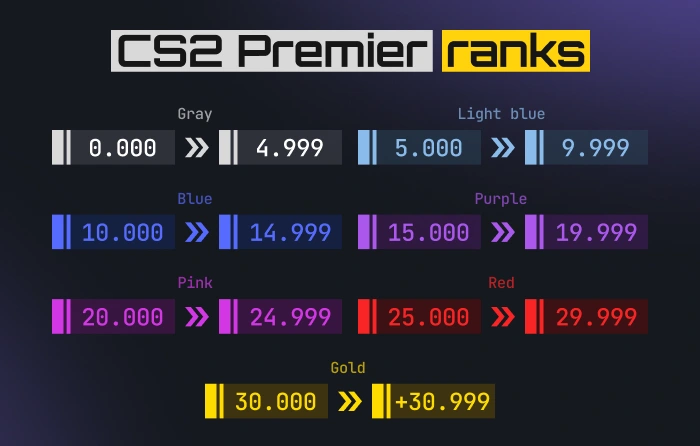
- Grey – 0–4,999. The starting tier for beginners and players grinding through their calibration games. Down here, people are still figuring out basic mechanics, positioning, and fundamental strats. Don’t treat this tier like it’s rock bottom. Everyone starts somewhere with a terrible aim, so try to remember your own learning curve.
- Light Blue – 5,000–9,999. The most populated tier in the entire game. According to Leetify, the massive bulk of the player base sits right here, with the global median rating hovering around 8,900. Players in this bracket understand basic economy and know the map layouts, but they seriously lack consistency.
- Blue – 10,000–14,999. Above average. Players in the Blue tier comfortably navigate most maps, understand their utility, and can successfully read opponent rotations. Breaking into this bracket is a solid achievement for the average player.
- Purple – 15,000–19,999. This is where the actual competitive grind begins. Players here grasp the meta, throw solid utility, and can adapt to the enemy team mid-match. Statistically, less than 15% of the player base ever reaches this level.
- Pink – 20,000–24,999. The elite zone. Under 3% of the entire player base holds a 20,000+ rating. Players up here consistently deliver high-level gameplay and often grind Faceit on the side.
- Red – 25,000–29,999. The top players in the region. Hitting Red means you are among the absolute best in your country or region. Less than 1% of players achieve this milestone.
- Gold – 30,000+. The highest rank in CS2 within the Premier system. This is professional territory. You’ll find people whose names regularly pop up on tournament brackets or big streaming platforms. This makes up less than 0.1% of the player base. Keep in mind, the rating doesn’t hard-cap at 30,000 – players can keep accumulating points to fight for the #1 spot on the global leaderboard.
How CS2 (CS:GO) Rating Is Calculated
Alright, this is one of the most vital sections for anyone actively trying to climb the ladder. Let’s be totally honest upfront: Valve flat-out refuses to reveal the exact math behind the CS2 (CS:GO) rank system. However, we do know a few hard facts.
What is locked in before the match begins
In Premier mode, the system shows you the exact rating you stand to gain or lose before the pistol round even starts. That number is completely fixed and does not change based on the final score. Meaning, a 13:2 blowout and a 13:11 squeaker award the exact same rating – because the payout was predetermined. This is a massive departure from the theories you read in most online guides.
Opponent rating – The primary variable
The system definitely factors in the average rating of both teams. If your squad looks weaker but pulls off the win, you get a bigger payout. If you crush lower-rated opponents, your gain shrinks. That’s exactly why your potential point gain shifts from lobby to lobby.
Individual performance
Valve has never officially confirmed that personal stats directly impact your CS Rating in Premier. Still, players notice discrepancies – sometimes identical match results yield slightly different rating adjustments for different players. Personal performance might carry some weight, but nobody knows exactly how much. Focus on winning the match as a team rather than baiting for personal kills. Again, this is highly speculative. Most players don’t notice it in their own games, and it mostly stems from rumors and random Reddit threads.
Volatility – Why your rating jumps randomly
One of the most confusing mechanics is when the game awards you +350 for one win and a measly +120 for the next. This happens because the system feels uncertain about your actual skill level – usually right after calibration or a long break – so it makes wider swings in both directions. Once your performance stabilizes, the gains and losses flatten out and become way more predictable.
Calibration effect
Your first 10 placement matches carry massive weight. The algorithm forms its initial opinion of your skill ceiling during this window. That’s exactly why you need to take your placement matches way more seriously than your average PUG.
How to Unlock Premier Mode in CS2
To gain access to Premier mode and start climbing the Premier CS2 ranks, you absolutely must buy Prime Status. This is Valve’s baseline requirement for participating in the next-generation ranked matchmaking.
Once you activate Prime, you have to grind through your placement matches, which dictate your starting CS Rating. During this phase, the algorithm heavily analyzes your match results, opponent strength, and round differentials to pinpoint your initial spot in the CS2 (CS:GO) rank system.
Your first rating drops after you finish this series of calibration games, but it’s nowhere near final. As you play more matches, the system continuously fine-tunes its read on your actual skill, meaning your starting number can shift dramatically early on.
This is precisely why placement matches play a critical role in establishing your baseline in Counter-Strike CS2 (CS:GO) ranks. Putting up consistent results during this initial stage makes the rest of your climb significantly easier.
CS2 Competitive Ranking System (Skill Groups)
If Premier is a brand-new ecosystem built from scratch, then CS2 competitive ranks are the comfort food veteran CS players have known and loved for years. Valve kept the classic Skill Groups structure but added a major update that made the system much more accurate. Let’s break it down.
How Competitive Mode Works in CS2
Competitive mode in CS2 runs the classic 5v5 format, with one major twist: the CS2 (CS:GO) ranks here are tied directly to specific maps instead of your entire account. To earn a rank on a certain map, you just need to win two matches on it – after that, the system assigns you a starting Skill Group.
This means you can hold wildly different ranks depending on the map. For example, you might flex a Legendary Eagle badge on Inferno, where you know every single angle and pop-flash, while simultaneously sitting at Gold Nova on Anubis because you’re still learning the basic rotations. And that is perfectly fine – the algorithm just honestly reflects your raw skill on every map individually.
Unlike Premier, there is no map veto phase, and you don’t get a fixed rating preview before the match. The actual mechanics for ranking up or deranking remain completely hidden. Valve won’t show you a numerical rating, only your Skill Group badge.
All CS2 Competitive Ranks (Skill Groups)
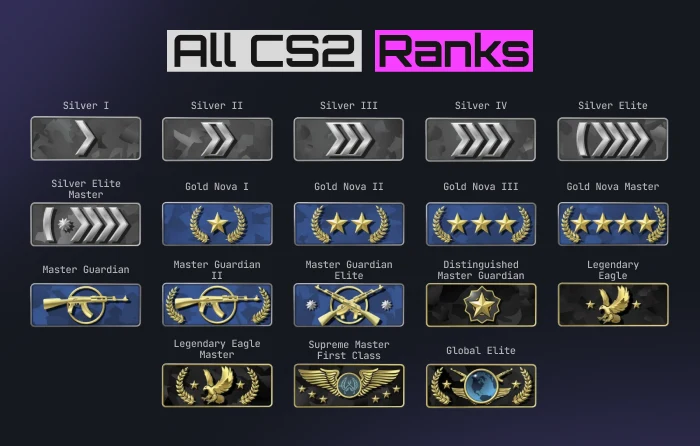
Silver – The beginner tier. Silver I, Silver II, Silver III, Silver IV, Silver Elite, Silver Elite Master. Players down here are just getting comfortable with the engine – working on raw aim, figuring out the economy, and learning map layouts. Don’t expect crazy coordinated teamplay, but it’s a great place to practice without heavy pressure.
Gold Nova – The average tier. Gold Nova I, Gold Nova II, Gold Nova III, Gold Nova Master. This is the most crowded bracket in all CS2 ranks. Statistically, roughly 35% of all Competitive mode players sit right here. They grasp the basics of the economy and hold standard map positions, but seriously lack consistency in their execution.
Master Guardian – Above average. Master Guardian I, Master Guardian II, Master Guardian Elite, Distinguished Master Guardian. This is where things get serious. Players reliably use utility, read enemy rotations, and understand basic team roles. Pushing into Master Guardian is a legitimately noticeable achievement.
Legendary Eagle – High tier. Legendary Eagle, Legendary Eagle Master. Proper tactical Counter-Strike starts here. Players at this tier understand meta-strategies, play disciplined situational CS, and rarely throw rounds away on dumb mistakes. Statistically, less than 10% of players hold these Counter-Strike CS2 (CS:GO) ranks.
Supreme Master First Class – Elite tier. You are one step from the mountaintop. SMFC players consistently deliver high-tier gameplay and are heavily active on Faceit or other third-party clients. Less than 2% of the player base reaches this bracket.
Global Elite – The peak. The highest CS2 (CS:GO) rank in Competitive mode. Under 1% of players. These aren’t just solid gamers – these are dedicated grinders who have poured thousands of hours into the engine to achieve actual mastery.
How Competitive Rank Is Calculated
The classic ranks in CS2 operate on a highly modified, complex Glicko-2 mathematical model that acts as a hidden MMR. The algorithm cares heavily about your raw win/loss ratio, but it heavily rewards your long-term consistency. If you string together a five-match win streak and drop one game, your Counter-Strike rank probably won’t move because the algorithm searches for extended patterns in your gameplay.
Your rang (CS:GO) CS2 also heavily relies on the caliber of your opponents. You have to consistently beat higher-ranked players to prove to the system that you actually deserve a promotion. Also, never forget about rank decay. If you stop playing a specific map for over thirty days, the game hides your badge until your next victory. Every single move you make on the server molds your final global offensive rank.
CS2 Premier vs Competitive – Key Differences
Alright, before we move forward, you need to clearly understand the fundamental differences when stacking up competitive vs premier CS2. Premier mode delivers a transparent numerical rating and global leaderboards, making it the perfect environment for a serious competitive grind. Classic Competitive caters more to practicing specific maps or playing in a far less stressful environment. Hardcore grinders always lean toward Premier thanks to the pick/ban phase and the generally higher skill ceiling.
| Feature | Premier Mode | Competitive Mode |
|---|---|---|
| Rating Type | Numerical CS Rating | Skill Groups |
| Map Selection | Pick/Ban veto system | Fixed map queue |
| Rank Scope | Global across all maps | Separate per map |
| Leaderboards | Global and Regional | None |
CS2 Rank Distribution (Premier & Competitive)
Analyzing player distribution helps you set realistic goals. Analytical platforms constantly scrape fresh data to show you exactly where the bulk of the community sits. We’ve pulled the most current percentages for you – we touched on them earlier, but they perfectly illustrate the overall CS2 rank list and how the player base actually splits up.
Premier Mode Distribution:
- 0–5k holds roughly 25% of the player base.
- 5–10k makes up the largest chunk, hovering around 35%.
- 10–15k accounts for a solid 25% of active players.
- 15–20k captures only 10% of the more ambitious grinders.
- 20k+ houses, about 5% of elite-level users.
- 25k+ sits at less than 1% of the total population.
Competitive Mode Distribution:
- Silver traps around 30% of the players.
- Gold Nova represents 35% of the average tier.
- Master Guardian gathers 20% of experienced fans.
- Legendary Eagle and above contain only 10% of the player base.
- Global Elite remains an exclusive VIP club for <1% of the community.
Let’s be real – players are constantly looking for accurate comparisons between different matchmaking clients, and you probably are too. Our unique chart lays out your direct CS2 Premier ranking equivalent on other popular matchmaking hubs. You can easily figure out your CS2 elo rank equivalent and see exactly how the modern ESEA ranking system stacks up against the official game modes.
| Premier CS Rating | Competitive Skill Group | Faceit Level | ESEA Rank |
|---|---|---|---|
| 0–4,999 | Silver I — Silver Elite Master | Level 1–2 | D- to D |
| 5,000–9,999 | Gold Nova I — Gold Nova Master | Level 3–4 | D+ to C |
| 10,000–14,999 | Master Guardian I — DMG | Level 5–6 | C+ to B- |
| 15,000–19,999 | Legendary Eagle — LEM | Level 7–8 | B to B+ |
| 20,000–24,999 | Supreme — Global Elite | Level 9–10 | A- to A |
| 25,000+ | Global Elite (Top Tier) | Level 10 (2000+ ELO) | A+ / Rank G |
| 30,000+ | Global Leaderboard | FPL-C / FPL | Rank S |
How to Rank Up Fast in CS2
Oh man, thousands of players ask this exact question every single day. Every gamer actively dreams of hitting the highest rank in CS2, but getting there demands absolute discipline. We’ve compiled the most effective strategies guaranteed to boost your CS2 (CS:GO) ranks and drastically improve your game sense.
But before you read these tips, here is an honest disclaimer: There is no magical shortcut to quickly inflate your CS2 (CS:GO) ranks. The only thing that actually works is systematically grinding specific mechanics. Like we said – discipline is everything, because that’s the only way to forge razor-sharp, automatic habits.
Improve Your Mechanics
Let’s be completely blunt: your priority is practicing your aim every single day because raw mechanics form your foundation. Without them, all the tactical knowledge in the world is useless because you simply won’t be able to hit the shots you need.
Aiming
The most reliable way to upgrade your aim is daily practice on custom maps like aim_botz or grinding Deathmatch servers. A simple 15–20 minute warmup routine before your main queue will yield visible results in just a few weeks. We highly recommend never skipping this step, even when you feel like your aim is already crisp – your mechanics decay way faster than you realize after a break.
Crosshair placement
This is easily the most undervalued skill among average players. Glue your crosshair to head level and hold the angles where enemies are forced to peek. You will win drastically more duels purely off positioning, without even having to flick. Mirage Prefire map is an incredible tool for dialing this in.
Recoil control
Every rifle in CS2 has a unique spray pattern you have to memorize and tame. Spend an hour in a practice server mastering your AK-47 and M4 sprays – it will literally pay for itself in hundreds of future rounds. You can find plenty of dedicated recoil maps hiding in the Steam Workshop. Trust us, there are tons of them.
Movement
Counter-Strafe – coming to a dead stop before you shoot – is a fundamental mechanic that way too many people ignore. Your running accuracy in CS2 is basically zero, making it absolutely critical to halt all momentum before you fire. It’s tough to master and takes real experience, playing against higher-ranked grinders who punish your mistakes, watching your own demos, and sweating it out on practice maps focused on jumps and movement mechanics.
Play for Round Wins, Not Kills
This section is a bit shorter because it only applies to a specific subset of players, but it might apply to you: playing solely for your K/D ratio. Sometimes people get completely lost in the sauce and play purely for stats, just so they can yell, “I dropped a 1.4 rating, what did you guys do?” at the end of a loss. That mindset doesn’t work. Stop hunting for useless exit frags and focus entirely on the map objective.
Your team only wins when you successfully plant or defuse the bomb. Try actually playing off your teammates, and watch your win rate spike. You also have to micromanage your economy perfectly. If you don’t fully grasp the buy system, we highly recommend reading our CS2 economy guide. Only call smart force buys when the entire team commits to a shared game plan.
Communication & Team Play
If you’re just a regular gamer and not Oleksandr’ s1mple’ Kostyliev’s secret alt account, you will never secure the highest CS2 (CS:GO) rank if you play muted. Memorize all the essential map callouts and feed clear, concise intel to your teammates. Master your utility to blind enemy AWPers, smoke off chokepoints, and help your squad execute onto sites safely.
Avoid Rank Decay
You have to maintain a steady grind to hold onto your hard-earned all CS2 ranks. Avoid taking massive breaks that automatically trigger the rank decay algorithm. Understanding exactly how seasonal resets work allows you to schedule your playtime and maintain your MMR.
Why Your CS2 Rank Might Not Increase
You’ve probably been there: you win five or six games in a row, and your rating barely flinches. Unbelievably frustrating, right? Why does this happen, and how do you fix it? It’s an open-ended question without a perfect recipe, but we can offer some solid insight into why the system is holding you back.
Opponent rating is too low
If you constantly beat teams with a significantly lower average rating, the algorithm hands out minimal points per win. This isn’t a bug. It’s basic logic. Beating someone worse than you doesn’t prove you deserve a promotion. That’s why trying to farm rating in low-tier lobbies is basically impossible – the math actively prevents it.
You win matches but lose rounds
Even if your team secures the W, if you personally lose the majority of your aim duels and single-handedly throw crucial rounds, the game notices. Remember that ranks in CS2 evaluate the complete picture of your impact, not just the final scoreboard.
Hidden rating gap
This is easily one of the most frustrating situations. You have enough wins to rank up, but your badge refuses to upgrade. The most likely explanation: the system isn’t convinced your current form is stable and wants a larger sample size of matches to confirm it. This happens constantly after a massive win streak – the algorithm slams the brakes to make sure your sudden success isn’t just a fluke.
Solo queueing against stacks.
If you solo queue and constantly run into coordinated 5-stacks, your actual skill ceiling might be much higher than your rank suggests. A stack’s communication and basic trading give it a massive advantage that raw individual aim struggles to counter. The fix is obvious but annoying: find at least one or two reliable players to queue with.
There are a handful of other minor reasons, but these are the primary culprits keeping you hard-stuck. Let’s be real, though – grinding the competitive ladder feels infinitely better when you’re rocking CS2 skins you actually love, which is exactly why checking a reliable CS2 skin market value platform is a total game-changer for comparing prices, sniping the best deals, and dodging overpriced listings.
Final Thoughts on the CS2 Ranking System
Ultimately, climbing the CS2 ranking system is undeniably tough, but that brutal challenge is exactly what makes finally leveling up so incredibly rewarding. Like any highly competitive skill, it demands strict consistency, focused practice, and a genuine drive to elevate your gameplay every single match.
The good news? You now understand exactly how the system actually works behind the scenes, giving you a massive tactical advantage over the rest of the player base. Just stick to the grind, trust the process, and you will definitely see that progress – keep following our blog to stay one step ahead of the meta!
FAQ
CS2 features two different systems for ranks in CS2 – Competitive mode uses the 18 classic Skill Groups from Silver I up to Global Elite, while Premier mode introduces a numerical CS Rating ranging from 1,000 to 30,000+.
All CS2 ranks in Competitive mode break down like this: Silver I through Silver Elite Master, Gold Nova I through Gold Nova Master, Master Guardian I through Distinguished Master Guardian, Legendary Eagle, Legendary Eagle Master, Supreme Master First Class, and Global Elite.
Competitive mode features 18 distinct Skill Groups. Meanwhile, Premier mode divides players into 7 color-coded tiers based on their numerical rating.
The highest CS2 (CS:GO) rank in Competitive mode is Global Elite, an exclusive milestone that less than 1% of the player base actually hits. If we look at Premier mode, the absolute peak is a numerical rating of 30,000+.
Yes, Global Elite still holds the crown as the top rank in CS2. However, you have to remember that the game also runs a completely different system in Premier mode, where the ultimate goal is a numerical rating of 30,000+.
Yes, CS2 uses an ELO-like system called CS Rating in Premier mode.
Win 10 matches in a specific map (Competitive) or play Premier to receive a CS Rating.
Complete 10 wins on a map (Competitive) or finish placement matches in Premier.
You need 10 wins per map in Competitive mode.
No, exact MMR is hidden, but CS Rating reflects your skill level in Premier.
Above-average ranks like MG–DMG (Competitive) or 10k+ rating (Premier) are considered good.
Gold Nova ranks or around 5k-8k Premier rating are considered average.
Most players fall around Gold Nova or mid-level Premier ratings.
The majority are in Gold Nova or mid-tier Premier ratings.
Around average level, similar to Gold Nova.
Yes, 14k is above average and considered strong.
High-level play, roughly equivalent to DMG/LE skill.
Yes, but it usually requires a streak of poor results.
Yes, inactivity or losing streaks can cause rank loss.
Yes, ranks can decay after inactivity.
Yes, inactivity can reduce your rating over time.
Rating gain depends on match difficulty, team balance, and hidden MMR.
Losing against weaker opponents results in bigger rating drops.
Individual performance has some impact, but winning matches matters most.
Yes, ties can result in small rating changes depending on performance.
Overtime games can lead to slightly adjusted rating gains or losses.
Yes, surrendering counts as a loss and reduces rating.
Yes, Premier is more competitive and skill-based.
No, they are separate ranking systems.
Players are ranked globally based on their CS2 Rating.
No, 4-player queues are not allowed in Premier.
It depends. Premier is official, while Faceit offers more competitive environments.
You can reset your profile rank to earn a Service Medal and start again.

Be the first to share your thoughts.