ADR in CS2: What is ADR in CS2?

Anyone who plays Counter-Strike 2 knows: simply killing isn’t enough. To improve your skill, you need to analyse your game. CS2 offers a wealth of statistics, but one of the most important is ADR. What is it? It shows how effectively you dealt damage to opponents in a round. This is what will tell you exactly how effective your actions were and how much contribution your teammates made. This is what makes it possible to evaluate your actions without fantasies and illusions. Below, we’ll explore how important CS2 ADR is, what it says about a player, how stable it is, and how to improve it.
What Does ADR Mean in CS2?
Understanding the CS:GO (CS2) ADR meaning is crucial. Let’s break it down. ADR stands for average damage per round. This concept includes all damage. If you kill an enemy with an AWP in hand, you’ll deal well over 100 damage. If you use a grenade and it hits multiple enemies, you can count on over 50 damage. Shooting an enemy in the arm with a pistol also counts. Every point counts. That’s why the question of what ADR is in CS2 isn’t about kills, but about consistently chipping away at an opponent’s health. Players who want to climb the CS2 ranks should pay attention to ADR first and foremost.
How is ADR Calculated in CS2?
In CS2, damage is tracked per round and a match. No confusion or secrets. ADR CS2 metric is the result of dividing the match damage value by the number of rounds. The outcome (win or loss) doesn’t matter. For clarity, here’s the formula: ADR = total damage ÷ number of rounds played. So, if your total is, for example, 1560 and the number of rounds played is 20, the division result is 78. Fortunately, the player doesn’t have to nervously calculate this every time; the system does everything for you. If you understand this formula, then it’s easy to understand how CS2 ADR works and why everyone considers it an important statistic.
What Counts Toward ADR?
The answer to the question “What is ADR in CS2” is practically clear. It only remains to understand exactly what is included in this metric. Everything you do to damage an enemy’s health goes into your CS2 ADR pool. Bullets from an assault rifle, pistol, or sniper rifle—obviously. Grenades also work. If you throw a Molotov cocktail and an enemy runs through the fire and loses 40 HP, consider that an ADR boost. Successfully stabbing an enemy is also a bonus. Even simply shooting an enemy in the arm with a Glock counts. This is how your total damage is calculated, which is then divided into rounds.
What Does NOT Count?
There’s no confusion here. CS2 ADR doesn’t count damage to yourself or your team, only damage to opponents. Second, any damage over 100 HP doesn’t count. An enemy has a maximum of 100 HP. If you headshot an enemy with 10 HP with an AWP, only 10 counts. That’s how ADR CS2 metric works: no extra damage, only actual hits.
What is a Good ADR in CS2?
Once you understand the meaning of ADR in CS2, the next logical question is: what number is considered normal? Over the years of the shooter’s existence, benchmarks have been established that define the skill of pro players and set the bar for newcomers.
ADR Benchmarks
Here’s a rough scale to help you evaluate your own CS2 ADR and that of others, even pro players:

- Below 60. Poor. You die early and rarely hit. This is the stage that everyone who likes CS goes through. You need to work on your aim and positioning.
- 60-70. Average. You have good rounds and bad ones. Here, everything depends on you and the skill of your opponents. Inconsistency is the main problem.
- 70–80. That’s normal, a solid base. You shoot confidently, and your team rarely criticizes you. If you maintain this level fairly consistently, that’s a very good result. But there’s still room for improvement; you can always do better.
- 80–95. This is the result that many dream of. This level is a sign of diligence and patience. This is the level that the pro players you know have.
- 95+. Elite. Pro players can achieve this level in a successful match. Not everyone can do it.
The important thing here is that to kill an enemy, you need exactly 100 damage. A high ADR CS2 metric doesn’t mean you need to kill every round. Few players consistently achieve a 100 ADR, and that’s normal. But if you play smart, a high ADR is quite realistically possible to maintain. CS2 ADR meaning isn’t just about numbers. Context matters.
ADR by Role
Your position on the team directly impacts your ADR in CS2:
- AWPer. One shot is often enough for them to deal 100 damage per round. That’s why snipers usually have high average damage. But if an AWPer hits an opponent in the leg, the damage is lower. So not every shot deals 100 damage.
- Entry fragger. This player is the first to reach the point. The risk is huge. They can deal up to 150 damage per round, or they can die without even taking a shot. This varies from match to match.
- Support. This is the player who throws smokes and flashbangs, highlights, and helps their teammates. Their CS2 ADR is almost always lower; they’re not focused on direct damage. But that doesn’t mean they’re useless. Without support, a team often falls apart.
Therefore, when evaluating CS:GO (CS2) ADR, always keep in mind the player’s role. For a support, 70 is normal, for an AWPer, 80 is so-so. It’s all relative.
Why ADR is Important in CS2
Beautiful kills are eye-catching, but a player’s true value is hidden behind the ADR CS2 number. This stat doesn’t measure the number of enemies killed, but the consistency of your pressure each round.
For every player, understanding ADR in CS2 is important. This is what records the actions that really matter for the outcome of the game. Everything is based on taking HP from opponents. Even if the kill doesn’t happen, the attempt still makes sense. A successful finish is as much your job as it is your teammates. So, the question “What is ADR in CS2?” has a very simple answer: it’s how much you can keep your opponents in fear and tension.
For CS2 analysts and coaches, ADR is the primary benchmark for player performance. A player with a consistently high (CS:GO) CS2 ADR means they can be relied upon in even the most challenging situations. Such a player is unlikely to let you down. K/D itself is just another characteristic for player evaluation. And just think about CS2 Wingman ranks: ADR is especially important there, because you fight a couple of enemies each round, and damage is everything.
ADR vs K/D Ratio vs Rating – Which Matters More?
In CS2, three metrics are usually important: K/D, ADR, and the overall score. Let’s break down what each means.
K/D is the ratio of kills to deaths. It shows how a player finishes enemies. It’s worth clarifying: one player might get 15 kills, but finishes almost everyone with 10 HP. Another player might only get 5 kills, but regularly deals 80-90 damage to enemies without finishing them. The second player has a higher ADR CS2 metric.
This is where CS2 (CS:GO) ADR comes in. Most players focus on kills, but ADR tells the whole story. Whether you’ve killed an enemy completely or knocked off 80 HP, it doesn’t matter; the damage counts. Rating (the overall score) is calculated based on kills, assists, and the bomb. So, dealing lots of damage but no kills means your score stays low. But ADR is high. Therefore, CS2 ADR is more accurate.
That’s why many consider (CS:GO) CS2 ADR the most reliable metric. It’s not about numbers, but about something much harder to assess: engagement in the process and understanding of goals. A consistently high ADR means you’re useful even without a ton of kills.
How to Improve Your ADR in CS2
If you understand the CS2 ADR meaning and want to improve your ADR, here are the concrete steps. No magic. Just practice and good habits.
Improve Aim
Start with aiming. Join deathmatch servers or aim trainers. The main rule: keep your crosshair at head level. In CS2, this gives you instant headshots and a sharp increase in your ADR. Learn the spray of each weapon. And remember: short bursts (2-3 rounds) are more accurate than wasting a full magazine.
Use Utility Properly
Grenades cause free damage. Throw HE grenades where opponents typically are, especially after planting the bomb. Molotovs cover entire avenues: the enemy either burns or runs into your bullets. Even if you don’t kill your opponents, the damage counts. Flashbangs don’t deal damage, but they help win firefights. What is ADR in CS2 without using grenades? Only half the job is done.
Positioning & Map Knowledge
Knowledge of the map, particularly the locations where opponents most often appear, is important for increasing (CS:GO) CS2 ADR. Keep these positions under your sights, but make sure you’re not seen. It’s better if you’re potentially vulnerable to only one opponent, not several. Besides, if you only play in one CS2 game mode, your Counter-Strike ADR may not reflect the full picture. You need an honest understanding and the best way to appreciate this is through competitive game modes.
Play for Damage, Not Just Kills
The most important thing: focus more on damage than on flashy kills. If you’ve hit an enemy for 40 HP, that’s already good. Don’t go for risky finishers; it’s often more profitable to stay alive and get more shots in the next encounter. Smokes and wallbangs are a great way to add damage without direct contact. Spam smokes, move, and reposition. Every point of damage contributes to your CS2 ADR.
And another tip: watch your demos. Note the moments where you didn’t deal damage but could have. If your problem is that death comes too quickly, it’s worth focusing on actions that will help you survive. Overall, applying all these tips will surely improve your CS2 (CS:GO) ADR. And just as importantly, your teammates will appreciate the effort. By the way, if you play against players with a high trust factor in CS2, then a high ADR is at least an indicator that you are playing well against fair opponents.
How to Check ADR in (CS:GO) CS2

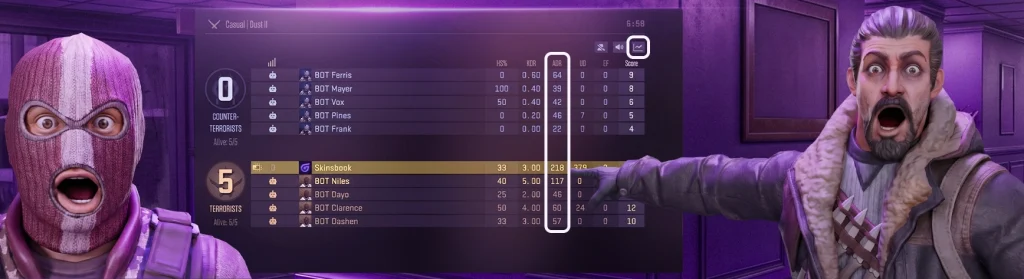
There are different ways to look at the ADR CS2 metric. It all depends on your curiosity. The first is during a match. It may be a distraction, but still… To do this, press Tab to open the scoreboard. By default, it displays columns for kills, deaths, and assists. To see your ADR specifically, right-click, then select “Cycle Stats” in the upper-right corner. The scoreboard will switch, and your average damage per round will appear.
The second is after the match. The game automatically displays the final stats. There’s no need to switch between them. Just find the ADR or (Damage per Round) line. This is the easiest way to find your CS2 ADR.
Why do this? By understanding what ADR is in CS2, you can track your progress more effectively. Check it after the match and see if the number has increased or decreased. Then draw your own conclusions. CS2 ADR’s meaning will become your benchmark for improvement.
Common Mistakes About ADR
Focusing on player capabilities only based on ADR is not optimal. The first possible mistake is thinking that a high CS2 ADR automatically makes a player better. Not always. Sometimes a player can rack up the damage but still lose rounds because he acts thoughtlessly and recklessly. ADR isn’t a metric that can reflect your interaction style with your team, your decision-making style, or your teammate support. And it certainly doesn’t reflect how you control the map or hold your positions.
Another common mistake is not understanding the role of support. These players usually have low CS2 ADR, but they’re more effective than some with high damage. Someone smokes up a lane, blinds an enemy, and their teammates can easily enter. But their ADR is low. So what? CS2 ADR, without taking into account the role, is a meaningless number.
Conclusion
Let’s summarize. CS2 (CS:GO) ADR is useful for any player. It’s an excellent indicator of a player’s performance. It shows a player’s contribution to a match more accurately than kills. If you have a consistently high CS2 ADR, you’re an asset to your team. Monitor this metric after each match. It will tell you where you’re improving and where you’re sagging. CS2 ADR is something worth improving. To do this, you should work on aiming, master grenade throws, and generally focus on high damage output, not just flashy kills. If you develop your ADR CS2 metric, your engagement in the game and your value to the team will definitely increase.
FAQ
This is something without which it is impossible to understand the player’s contribution to the defeat of opponents. The player's task is to take away HP from the opponent; the task of the adr is to show how well this was done.
Just divide your total enemy damage level by the number of rounds played.
ADR counts every hit you make on an enemy: bullets, grenades, Molotov cocktails, knives. It doesn't apply to you or your team.
Yes, because ADR provides more information, it's fairer. A player can kill players with 10 HP and have a ton of kills, but his ADR is low.
The average player holds 60–70. The number generally depends on rank and role.
If ADR 80+, then this is the level of pro players.
An ADR below 60 is considered quite poor. This means the player rarely hits and dies frequently.
Yes, that's a good level. 70-85+ is the level for pro CS2 players.
This is a very respectable level, demonstrated from time to time by top pro players, such as Mathieu Herbaut and Nikola Kovač.
Yes, but that happens very rarely. For example, the donk player showed ADR at level 140.
Technically, a player can have such a stat, but it would have to be an easy match, with weak opponents.
The impact is indirect. Rank increases with victories. And winning is easier if you have a high ADR.
This is possible. Victory depends not only on damage but on a host of other factors: decisions, teamwork, money, and the round situation.
To do this, you need to practice aiming. Keep your crosshair at head level. Throw grenades where the enemies are. Try not to die early in the round. All in all, this gives you a good result.
After the match ends, you can view this data without any additional actions. But you can do this during the match. Just press Tab, then right-click and select Cycle stats.
The basis for ADR calculations is the same in both versions. But some game conditions have changed, for example, the operation of grenades. This can partially influence how a player accumulates ADR.


Be the first to share your thoughts.